Project
DEAD WHITE MAN'S CLOTHES
2016 - 2022 | PAST
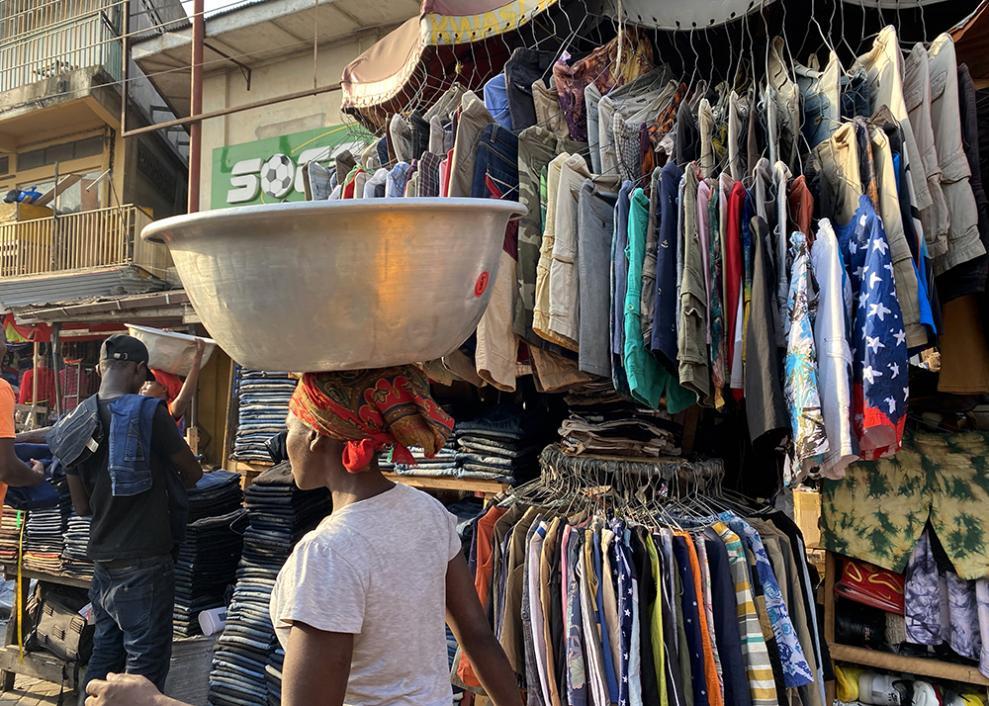
Although nearly everyone dealing in secondhand clothes today knows that most of the clothing is originally given away by people who are still alive, the Twi phrase Obruni Wawu is still employed to describe secondhand clothing in Ghana. This phrase translates to Dead White Man’s Clothes and for us it speaks to the absurdity of the waste that we, as a society, create as a byproduct of our exploitative overconsumption and overproduction. Abundance and excess are not the same thing. Overconsumption is not a burden carried entirely by the consumer. Overproduction is not a burden carried entirely by the producer. These phenomena are interconnected and affect all of us, regardless of our role or our position in the global North or South. Kantamanto Market and the dumpsites surrounding Accra are specific areas where the impacts of this cycle are greatly evident, but so too are the malls of America and the High Streets of Europe.
Our research based on hundreds of surveys and interviews and thousands of hours of observation and garments sorted since 2016 has shown that roughly 40% of the millions of items that pass through Kantamanto Market every week leave the market as waste. These hundreds of thousands of garments on a daily basis represent one of the largest consolidated sources of waste in the city of Accra. And they are just the tip of the iceberg in relation to the global crisis of fashion’s waste. As an organization we have played a leading role in documenting many of the widespread impacts of this waste.
Just as the amount of waste is staggering, so too is the effort to recirculate clothing. Kantamanto is the world’s largest reuse hub. 30,000 people work to add value to garments through sorting and merchandising, remanufacturing, tailoring, screen printing, washing, ironing and dying, among the nearly countless tasks of transformation that are performed to recirculate roughly 25 million garments a month, far more than any dedicated digital clothing resale platform in the Global North. The many lessons of craft of use that are found throughout Kantamanto are the very lessons that we, as a society, must learn if we are to end fashion’s waste crisis.
To consider the impacts of the secondhand clothing trade within Kantamanto Market and across Ghana and West Africa more broadly calls for the consideration of global supply chains and socioeconomic systems, systems indeed spawned by the White Man.
Today Kantamanto Market, located in the center of the city of Accra, operates with high speed internet in the pocket of nearly every trader and with an increasing number of malls reminiscent of suburban USA offering new shopping experiences around the sprawling city and suburbs of Accra. These new technologies and developments are changing the decades-old secondhand clothing trade. Entrepreneurs scout out the best items from various market traders in order to sell at a markup on Instagram. Younger and wealthier customers spend time in the air conditioned malls. Whether or not they spend their money in the malls, the market scene of organized chaos that dominates Kantamanto Market is no longer the only place to buy European style clothes or to do business. How Accra as a society comes to balance the various tensions behind this evolving landscape is an important indicator of the city’s future both ecologically and economically and is a focus of our current work.